


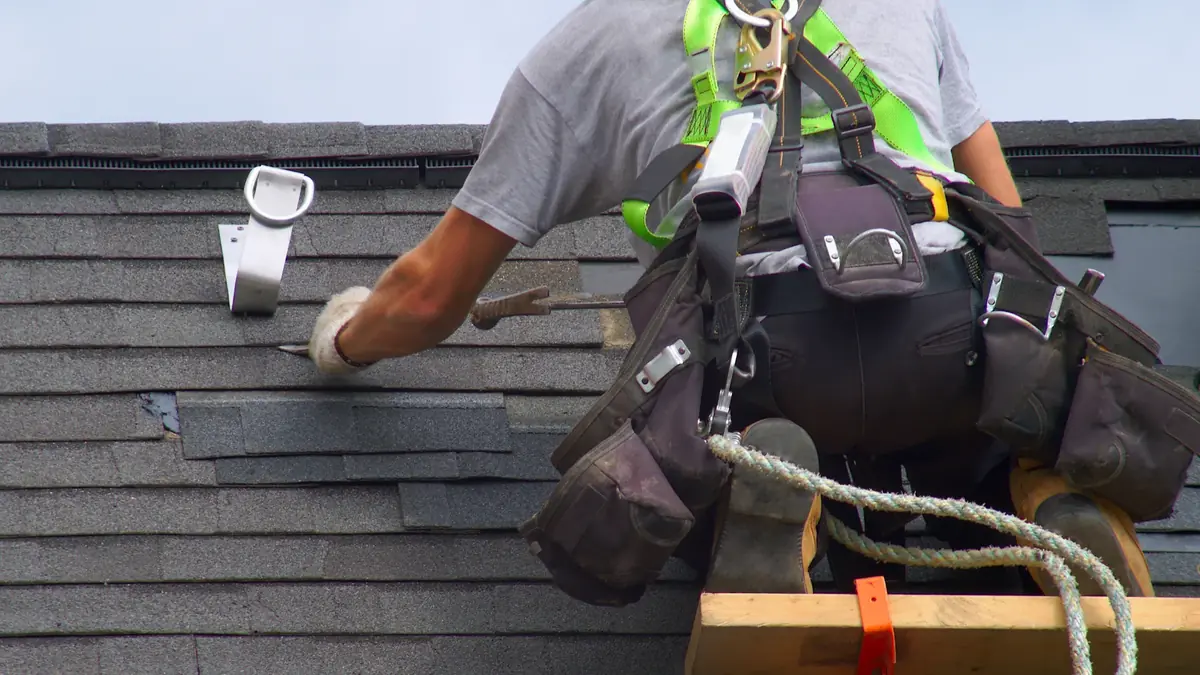
Across the repair calls we've run in the Tri-Cities over the last several years, four scopes account for most of the work. Here's what they are, in rough order of frequency, plus what causes each and how we approach it.
1. Flashing failure around a chimney or skylight
By a clear margin, the most common repair we run is flashing work — usually around a chimney, occasionally around a skylight, sometimes at a sidewall where roof meets wood siding.
Why it fails: the metal flashing is fine. The sealant between the flashing and the masonry isn't. Tar-based caulks dry out and crack in 5–10 years; modern polyurethane sealants last 15–20. A roof installed in 2008 with old-style tar usually starts leaking around the chimney sometime between 2018 and 2023 — and that's the call we get.
What the repair involves: typically we tear back 2–4 courses of shingles around the chimney, remove the old step flashing, install new aluminum step flashing (overlapped and woven into the shingle courses), set a new chimney pan or apron at the top, and seal with a 30-year polyurethane. Most jobs are 3–5 hours. The flat price depends on chimney size and brick condition — we quote it after walking the roof.
What you can do: if you can see your chimney from the ground, check the area where the brick meets the roof after a heavy rain. Water stains running down the brick, or a wet spot on the ceiling near the chimney, are the early warning.
2. Missing or wind-lifted shingles
The second-most-common scope, especially after the spring and fall storm seasons.
Why it fails: the asphalt-to-asphalt thermal seal on shingles forms over the first few weeks after installation. If your roof was put on during cold weather, that seal may not have fully formed, and high wind exposes the weakness. Old roofs (year 15+) lose seal strength even with proper installation, and a 50+ mph gust will lift shingles.
What the repair involves: replace the missing or lifted shingles, hand-seal the new ones, and check the surrounding field for shingles that look loose but haven't blown off yet. Usually 1–3 hours for a typical scope. The flat price depends on what we find when we get up there.
The trap: wind-lifted shingles that haven't blown off are almost more dangerous than missing ones. They look fine from the ground but the seal is broken, so water gets underneath during the next rain. After any 40+ mph wind event, a 15-minute ground inspection of your roof is time well spent.
3. Pipe boot or vent collar leak
Every plumbing vent stack that comes through the roof has a rubber gasket (a "boot") sealing it to the surrounding shingles. There's also a metal collar on top of the boot in most modern installs.
Why it fails: the rubber dies. Tennessee UV + humidity + freeze-thaw cycling kills neoprene boots in 8–12 years. The rubber cracks at the base of the pipe, and water tracks down the inside of the pipe and into your attic. The boot looks intact from the ground; you have to be on the roof to see the cracking.
What the repair involves: swap in a new boot (typically a lead-and-rubber hybrid that lasts 20+ years), reseat the collar, and reseal. 30–60 minutes per boot. you get a flat written price after inspection — written in house.
What you can do: check your attic ceiling around plumbing vents for staining. Pipe boot leaks usually show up as a small wet ring on the attic insulation, often before they're visible on the finished ceiling below.
4. Valley deterioration
The valley is the V-channel where two roof planes meet. It carries more water than any other section of the roof.
Why it fails: modern valleys are either open-metal (a long aluminum or copper channel) or closed-cut (shingles lapped across). Both wear faster than the surrounding field because of water volume. After 15–20 years, the valley shingles are usually visibly thinner than the rest of the roof, or the metal has corrosion pinholes.
What the repair involves: tear back the shingles along the valley, install ice-and-water shield underneath, replace the valley metal if it's there, re-lay shingles. A typical 12-foot valley re-do is a half-day job. The flat price depends on valley length and what we find under the existing shingles.
What you can do: valley leaks tend to show up inside the house as a wet spot directly below the valley line — sometimes well down the slope, not at the eave. If you see staining on a ceiling but can't trace it to a fixture, the valley above it is the first place to check.
What we'd suggest, in order
If your roof is year 8–15 and has never been repaired:
- Have someone look at your flashing every 5 years — that's the failure mode that catches most people.
- After any storm with winds over 40 mph, walk your property and look at the roof from the ground. Missing shingles are easy to spot.
- Check your attic twice a year — once in spring, once in fall — for any signs of water staining.
Almost every leak we see is one we could have caught before it became a leak. The Palisade inspection visit is free, and we'd rather do a small repair this year than a deck-rebuild repair in three years.
Have questions about your own roof? Book a free on-site visit — every estimate is written in house. Get your estimate →