


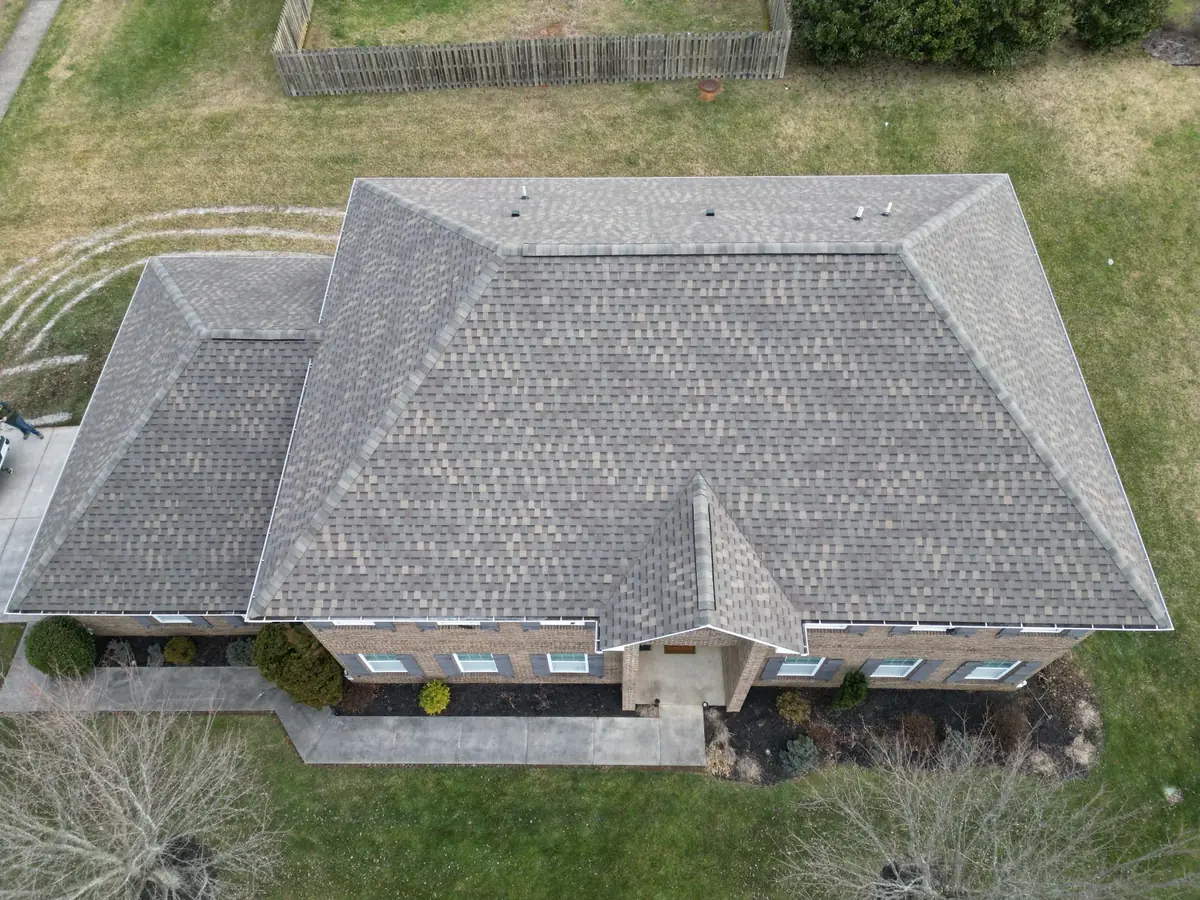
When Christian walks a roof, he's checking the same 12 things every time, in roughly the same order. Knowing what those are is useful for two reasons: you can spot the same things yourself between inspections, and you can ask informed questions when a contractor presents findings.
Here's the list, top to bottom.
On the roof
1. Shingle condition (field). Are the shingles lying flat, sealed, with all the granules intact? Curling edges signal heat damage or end-of-life. Bare spots — where granules have washed off — accelerate as they age, because the asphalt underneath the missing granules is exposed to UV.
2. Shingle condition (north slope). The north-facing slope sees less sun, more moisture, and more shade. It's almost always more weathered than the south slope, and it's where moss and algae establish first. Black streaks running down the slope are usually Gloeocapsa magma — an algae, harmless cosmetically, but a sign the shingles are holding moisture longer than they should.
3. Ridge cap. The ridge cap shingles take the most weather of any shingles on the roof. Lifted ridge caps usually mean the rest of the roof is older than it looks.
4. Valleys. The V-channels are the highest-stress water-carrying surfaces. We check for thinning shingles, debris accumulation, and any visible underlayment exposure.
5. Flashing — chimney. Step flashing should be tight to the chimney, sealed with polyurethane (not tar), with no visible gaps. Counter-flashing (the cap piece set into the masonry) should be intact and the masonry behind it not cracked.
6. Flashing — sidewalls. Anywhere roof meets siding, look for step flashing weaving up the wall, and counter-flashing or kickout flashing at the bottom edge directing water away from the wall.
7. Pipe boots and vents. Each plumbing vent, exhaust vent, and bath fan vent has its own seal. The neoprene rubber gaskets crack 8–12 years in; lead-and-rubber hybrid boots last 20+ years.
8. Ridge and soffit ventilation. A balanced ventilation system has air intake at the soffits and exhaust at the ridge. Blocked soffit vents (the most common problem) make the attic run hot and shorten shingle life by 3–5 years.
At the eaves and gutters
9. Drip edge. A formed metal strip under the shingle starter course at the eaves. Older homes often don't have it; that's a common entry point for water getting up under the first course of shingles.
10. Gutter condition and slope. Gutters should slope toward the downspouts, with all joints sealed and no sagging sections. Detached or back-pitched gutters dump water against the fascia.
11. Fascia and soffit. The fascia is the board running along the eaves; the soffit is the underside. Water staining, soft spots, or visible rot here usually traces back to a roof problem upstream — failing flashing, blocked gutters, ice damming.
In the attic
12. Attic from the inside. A 10-minute walk-through with a flashlight: look for water staining on the underside of the decking (any color other than clean lumber), check for daylight visible at the eaves or ridge, smell for mustiness, and verify insulation is dry. Attic problems are the single best early-warning system for a roof that's about to need work.
What you can check yourself, twice a year
Two ground inspections a year — once in late spring, once in late fall — catch most issues before they turn into repairs. From the ground with binoculars:
- Scan the field for missing shingles or visible curling.
- Look at the ridge — any bare or lifted areas.
- Check the area around the chimney for lifting flashing or wet brick.
- Walk the perimeter and look up at the underside of the eaves for staining or peeling paint.
- Check the gutters for shingle granules accumulating below downspouts (one of the cleanest signals that the shingles are losing their protective coating).
In the attic:
- Pop the attic hatch, take a flashlight, and look at the underside of the decking. Clean lumber = no leak issues. Anything else = worth a closer look.
- Sniff. A dry, slightly woody attic is healthy. A musty smell is not.
- Touch the insulation. Dry is normal. Damp is a problem.
When to call us
If anything in your own inspection looks off, that's a free Palisade roof inspection. We'd rather catch a small flashing repair than wait until the decking is rotted and the repair gets much larger. We won't pitch a replacement on a roof that just needs a repair, and we won't pitch a repair on a roof that's at the end of its life — every assessment is written in house.
Have questions about your own roof? Book a free on-site visit — every estimate is written in house. Get your estimate →