

How to pay for a roof. Honestly.
We do work with a couple of financing partners if you need one — but we don't lead with it, because the math usually works better elsewhere. This page is what we'd tell our own family — the six common paths, what each one costs in 2026, and which one we'd pick in your shoes. If you're still sizing the total, here's what a roof replacement actually costs in Tennessee. If financing through us is the right fit after reading, ask Christian at the estimate.
A note before we start: we're roofers, not financial advisors. Talk to your bank, your credit union, or a fee-only financial planner for guidance specific to your situation. Rates and tax-credit details change between when we publish this and when you read it — verify anything important with the source before you sign.
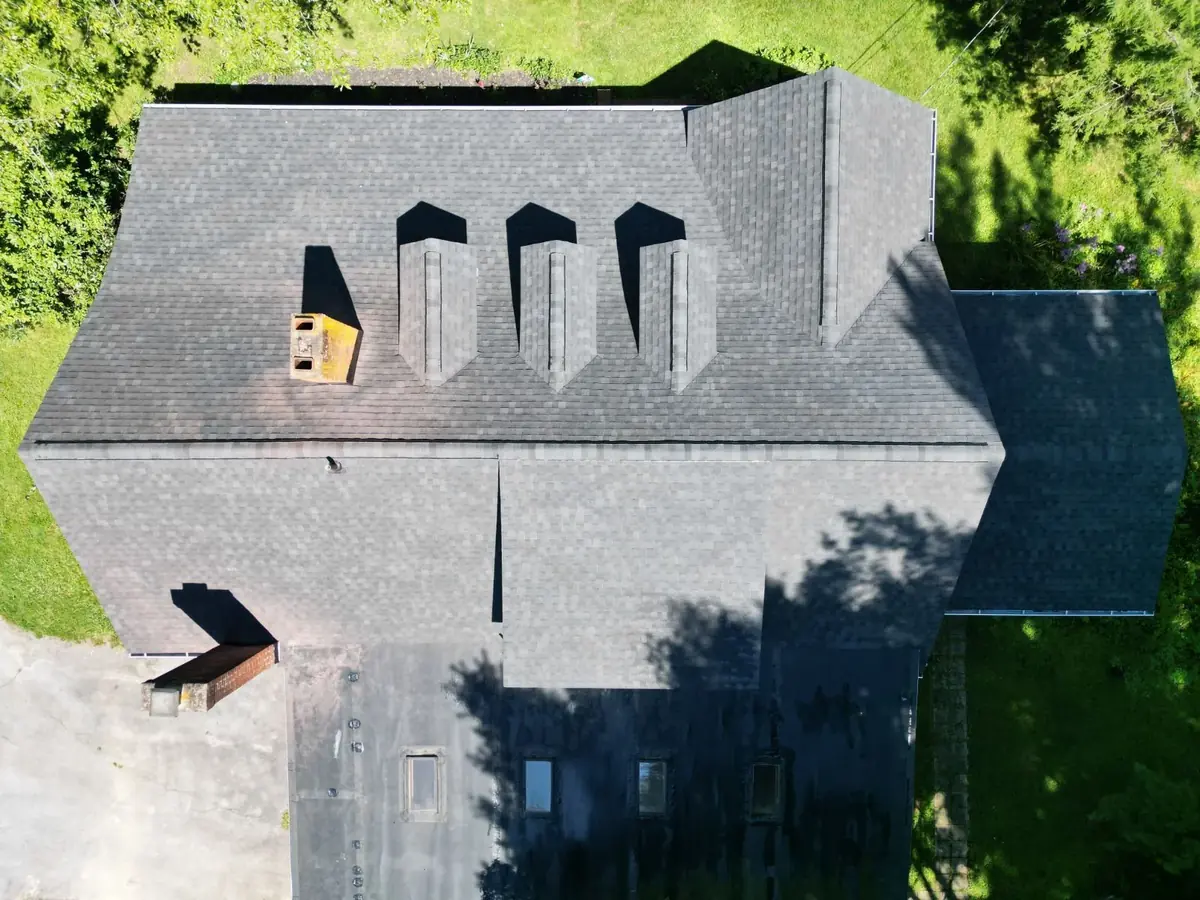
The roof gets paid for one of six ways.
Homeowners insurance.
If your roof was damaged by a sudden, accidental event — wind, hail, a fallen tree, ice dam — your policy probably covers it. Age and wear-and-tear are not covered.
What you'll pay: your deductible. For most Tri-Cities policies that's $1,000–$2,500, sometimes a 1–2% "wind/hail deductible" instead — read your policy declarations page.
How long it takes: 21–45 days from claim filing to the ACV check on routine claims, longer after wide-area storms when adjusters stack up. Active leaks get a tarp first; the claim process runs in parallel.
ACV vs. RCV — the part that decides how much you actually net. An ACV-only policy pays the depreciated value of the roof and stops. An RCV policy pays ACV first and releases the depreciation holdback after the work is done — so the same $20,000 claim with $5,000 of depreciation pays $15,000 up front and $5,000 after completion. Most modern Tennessee dwelling policies are RCV, but check your declarations page. If it says ACV on the dwelling, your math changes.
Where we fit: we document the damage for free, meet your adjuster on the roof, and write the estimate in Xactimate-compatible line items so the numbers match. We don't ask you to waive your deductible — that's insurance fraud under Tenn. Code Ann. § 56-7-2602, and any contractor who offers to is a contractor you shouldn't hire.
Cash.
Boring, but it's the cheapest path. Zero interest, zero origination fee, zero credit pull.
What you'll pay: the estimate. We charge the same whether you pay cash, card, or financing — we don't bake a "dealer fee" into the headline number.
How long it takes: as long as the install. Deposit and payment terms are stated in your written estimate on a per-project basis.
The honest caveat: don't drain your emergency fund to dodge a few percent of interest. If paying cash means six months of zero cushion, a HELOC at current rates is the better trade.
Home equity line of credit (HELOC).
A revolving credit line secured by your home equity. You draw what you need, pay interest only on the draw, and have 10 years to repay. Currently the lowest-rate financing available to most homeowners.
What you'll pay: in the lower-rate tier of home-financing options — typically the cheapest way to finance a roof for homeowners with equity. Credit unions tend to beat national-bank rates by a meaningful margin. The rate is tied to prime — when prime moves, your payment moves. Interest may be tax-deductible if the funds are used for home improvement — ask your accountant.
How long it takes: 14–28 days to close. Not the right answer if your roof is leaking today.
Where to go locally: any Tri-Cities credit union or community bank is worth a phone call before you talk to a national lender. Local credit unions in particular tend to beat national-bank rates on HELOCs and are set up to handle home-equity loans on local properties quickly. Walk into the one closest to you, or call.
Home equity loan.
A second mortgage. Lump-sum disbursement, fixed rate, fixed monthly payment for 10–15 years. Similar paperwork to a HELOC but the rate is locked.
What you'll pay: typically a small premium over the equivalent HELOC variable rate in exchange for a locked monthly payment, amortized over 10 or 15 years. Use any home-equity-loan calculator to model your specific scenario.
How long it takes: 14–28 days to close — same as a HELOC.
When to pick this over a HELOC: if rates are likely to rise, or if you want one predictable line on your monthly budget. The trade-off is you can't redraw the credit line later.
True 0% intro-APR credit card.
A handful of major issuers offer 12–21 months of real 0% APR on purchases — not deferred interest. If you can confidently pay the balance inside the promo window, this is the cheapest debt you'll ever take.
Right for: good-credit homeowners with a job under roughly $15,000 they can pay off in 12–18 months. Repairs and smaller asphalt replacements fit cleanly.
Wrong for: anyone who would only make minimum payments. The APR after the promo period jumps to standard credit-card rates — in the highest tier of consumer debt.
Watch out for: "store cards" and contractor-branded cards. Many of those look like true 0% APR but are actually deferred-interest products. Use a card from a major issuer with the promo terms in writing — not a card the contractor hands you on the porch.
Contractor financing.
Loans originated by a third-party finance company (GreenSky, Service Finance, Regions Home Improvement, Synchrony, Wisetack, Hearth, Foundation Finance) and offered through the roofing contractor. The contractor swipes you, the lender approves in minutes, the work starts the same week.
What it actually costs: two things. First, the headline APR — in the higher-rate tier of consumer loans (well above HELOC territory), varying with credit. Second, the dealer fee — the contractor pays the lender a meaningful percentage of the loan principal to originate it, and that fee is almost always baked into the price quoted to you. So you pay it twice: once in the inflated cash price, again in interest over the loan term.
The "0% for 12 months" trap. These are deferred-interest loans, not real 0% loans. Interest accrues silently at standard credit-card APRs the entire promo period, and if you don't pay 100% of the balance by month 12, every month of interest is billed retroactively from day one — meaning the principal can grow by a significant share overnight. The Consumer Financial Protection Bureau took action against GreenSky in 2021 for $9 million in loan refunds plus a $2.5 million civil penalty for letting contractors enroll customers in financing without authorization — deferred-interest products have drawn ongoing CFPB scrutiny across home improvement, retail, and medical financing.
Why we don't push it: typical contractor-finance terms make us mark up every estimate a meaningful percentage to absorb the dealer fee. We work with a couple of partners for customers who specifically need them, but we'd rather quote the honest number and let you choose the cheapest path for your situation.
The six paths at a glance.
| Path | Rate tier | Time to fund | Best for |
|---|---|---|---|
| Insurance claim | Deductible only | 21–45 days | Storm or hail damage |
| Cash | 0% | Same day | You have it spare |
| HELOC | Lowest-rate tier (variable) | 14–28 days | Equity + time |
| Home equity loan | Lowest-rate tier (fixed) | 14–28 days | Fixed-payment preference |
| True 0% intro-APR card | 0% promo (then highest-tier credit-card APR) | Same day | Under ~$15K, paid off in promo window |
| Contractor financing | Higher-rate tier + dealer fee | Same day | Last resort |
We don't quote specific APRs here because rates change weekly and we don't want to point you at a stale number. Verify current rates directly with the lender before signing. Your actual rate depends on credit profile, loan-to-value, and what the lender is offering this week. This page is informational, not financial advice.
Things you should know if you live in this state.
Your 3-business-day right to cancel — twice.
Tennessee gives roofing customers two separate three-business-day cancellation rights, not one. Most contractor templates miss the second one.
- Home solicitation cancellation (Tenn. Code Ann. § 47-18-701 et seq.) — if you sign any contract over $25 at your residence (rather than at the contractor's office), you have until midnight of the third business day after signing to cancel for any reason, in writing. The contractor is required by law to tell you about this right and give you a cancellation form. If somebody pressures you to "sign tonight or the price goes up," that's exactly the situation this statute was written for.
- Insurance-funded roofing cancellation (Tenn. Code Ann. § 62-6-602) — if your project is paid in whole or in part from a property/casualty insurance policy, you have an additional three-business-day right to cancel after your insurer issues a coverage decision in writing. Within 10 business days of cancellation, the contractor must return all payments except for documented emergency repairs you authorized in writing.
Contractor licensing thresholds.
Under Tenn. Code Ann. § 62-6-101, contracts of $25,000 or more (labor + materials) require a full Tennessee state Contractor License. A separate Home Improvement License governs work between $3,000 and $24,999 — but only in nine specific counties (Bradley, Davidson, Hamilton, Haywood, Knox, Marion, Robertson, Rutherford, and Shelby). Washington County is not on that list, so most of the Tri-Cities falls outside the intermediate registration tier. Either way, verify any contractor's license on the Tennessee Department of Commerce & Insurance website before signing.
No residential PACE in Tennessee — and that's a feature.
Tennessee's PACE-enabling legislation (HB 667, 2021) only authorizes Commercial PACE for non-residential properties. Residential PACE for single-family homes is not available in Tennessee — which is honestly a good thing. Residential PACE in California and Florida has produced enough property-tax-lien horror stories that the CFPB issued a final rule tightening ability-to-repay requirements. If somebody offers you "PACE" for a roof in Tennessee on a single-family home, something's wrong.
Federal tax credits and TVA rebates.
The Energy Efficient Home Improvement Credit (IRC §25C) was terminated for property placed in service after December 31, 2025, by the One Big Beautiful Bill Act signed July 4, 2025. For a roof installed in 2026, there is no federal residential tax credit on the roof itself. If we're tearing into your attic anyway, TVA's EnergyRight program (administered through your local power company) still covers attic insulation, air sealing, and HVAC measures — up to roughly $1,500 in rebates that have nothing to do with the shingles.

The cheap-for-us option is rarely the cheap-for-you option.
Most contractor-financing terms require us to quietly raise our quoted prices a meaningful percentage to absorb the lender's dealer fee. That fee then earns interest for the life of the loan, on top of the headline APR.
So our default is to:
- Quote you the honest cash price.
- Tell you what the local credit unions are charging this month.
- Surface our financing partners only if you've ruled the cheaper paths out.
If you find a real 0% offer — some manufacturers occasionally run real promotional financing through Atlas or GAF — we'll honor it and adjust the paperwork. We just won't pretend a dealer-fee loan is a favor we're doing you.
The same is true of "buy now, pay later" and same-day signature pressure. A roof is a 25-year purchase. There is no honest reason to sign for one today.
Four ways to pay for a roof that almost always end up costing more.
- 401(k) or IRA early withdrawal. A pre-59½ withdrawal is generally a 10% penalty plus ordinary income tax. For most working homeowners, that's an effective hit of roughly 30–35 cents on the dollar — higher if you're in a 24%+ bracket. A $15,000 roof can cost $20,000–$24,000 of retirement balance. Almost never the right move.
- Reverse mortgage. Built for long-horizon retirement cash flow, not a one-time repair. Wrong tool.
- Payday and cash-advance products. APRs in the triple digits. Don't.
- "Today only" pressure financing. A storm-chasing crew offering 0% same-as-cash if you sign before they leave is the textbook scenario the Tennessee 3-day cancellation right exists for. Take the 72 hours. Read everything. We'll still be here.
What we'd pick in your shoes.
| If you have… | And the job is… | Likely best path |
|---|---|---|
| Significant home equity, good credit | Any size | HELOC or home-equity loan |
| Limited equity, good credit, can pay in 12–18 months | Under ~$15,000 | True 0% intro-APR credit card |
| Storm or hail damage | Any size | Homeowner's insurance proceeds |
| Active leak, no funds, no equity | Under ~$5,000 repair | Ask about a split-payment arrangement, or a personal loan |
| Roof 18+ years, no urgency | Future replacement | Save 6–12 months and book a late-January or February install for off-season pricing |
When deferring is the smarter call.
- 6–12 months of roof life left and no leak: Save through the window. Book a late-January or February install for off-season pricing and a more relaxed crew calendar.
- Active leak: Don't wait. Interior damage compounds, and most policies won't cover secondary damage from a leak you knew about and ignored.
- Already in a claim: Finish it. Most carriers give you 12 months from the date of loss to complete the work and collect depreciation; don't lose that window.
- The math doesn't work and the roof is still healthy: Defer a year. A well-maintained 20-year roof at year 19 will usually make it to year 22 with a flashing repair and attentive attic inspection. Don't borrow at HELOC rates to replace a roof that's still doing its job.
About paying for it.
Does Palisade Roofing offer financing?
Yes — we work with a couple of financing vendors, but we don't push it. The easiest financing for the contractor is almost never the cheapest financing for the homeowner, so before you sign anything, look at a local credit union, a HELOC through your existing bank, or a true 0% intro-APR credit card for smaller jobs. If those don't fit your situation, ask Christian at the estimate.
What is the cheapest way to pay for a roof replacement?
For most East Tennessee homeowners with equity, a HELOC or home-equity loan is the lowest-cost option — typically in the lowest-rate tier of home-financing options, with the interest potentially tax-deductible if the funds are used for home improvement. Cash is cheaper still if you have it without straining your emergency fund. Contractor financing is usually the most expensive path because the dealer fee is baked into the contractor's quoted price.
Will homeowners insurance pay for my roof?
It depends on the cause. Sudden, accidental events — wind, hail, fallen tree, ice dam — are typically covered. Gradual wear and age-related failure are not. If your roof is under 20 years old and you've had a recent storm, a claim conversation is worth it. We document storm damage at no cost and provide the photo evidence your adjuster needs.
How long does a HELOC take to close in Tennessee?
Most local Tri-Cities credit unions close a HELOC in 14–28 days. A home-equity loan is similar. Not the right path if your roof is actively leaking today — call us first, we'll tarp, then you can take the time to shop the loan properly.
What about "0% financing" promotions?
Read the fine print. Most "0% for 12 months" contractor offers are deferred-interest loans — if you don't pay the full balance by the deadline, every month of accrued interest is added retroactively. The CFPB took action against GreenSky in 2021 over exactly this category of issue. True 0% APR credit cards from major issuers exist separately and can be a good fit for smaller jobs paid off inside the promo window.
Do you offer a discount for cash?
Our base price doesn't have financing markup baked into it, so there's no "financed price vs. cash price" gap to discount. We do offer real off-season discounts (off-season pricing) for jobs booked in late January or February when our schedule is light.
What protections do I have under Tennessee law if I change my mind?
Two cancellation rights. Under Tenn. Code Ann. § 47-18-701, if you sign at your home you have three business days to cancel any contract over $25 — for any reason, in writing. Under Tenn. Code Ann. § 62-6-602, if the job is being paid from insurance proceeds, you get an additional three business days after your insurer issues a coverage decision. The contractor must return all payments within 10 business days of a valid cancellation. Always verify a contractor's license on the Tennessee Department of Commerce & Insurance website before signing.
Can you start work before insurance pays?
We can usually schedule once you have written claim approval and the ACV check is in hand (or a confirmed direct-to-contractor payment arrangement). We don't advance funds against pending claims, and we won't waive or absorb your deductible — that's an insurance-fraud red flag under Tenn. Code Ann. § 56-7-2602, not a favor.
Get the honest number first.
Pick the financing once you know what the roof actually costs. The estimate is free and there's no pressure to decide on the spot.