

The metal vs. asphalt question is the one we get the most emotion on, in both directions. People who love metal love it like a religion. People who hate it usually had a bad experience with a 1980s ag-metal install. The honest answer is mostly math, with three regional variables that matter specifically in East Tennessee.
The lifespan math
In our climate, you should expect:
- Standard architectural asphalt (Atlas Pinnacle Pristine, Owens Corning Duration): up to 50 years when installed to manufacturer specs.
- Impact-resistant Class 4 asphalt: at the top of the asphalt range under the same conditions.
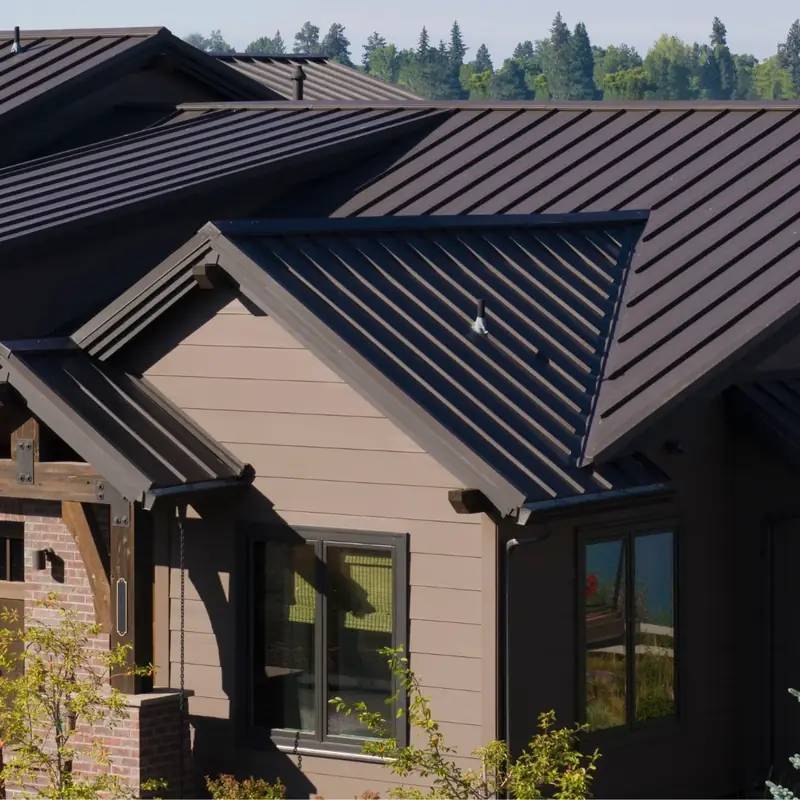
- Standing-seam Galvalume metal: up to 50 years when installed to manufacturer specs — in our climate, quality metal and quality asphalt live similar lifespans, with metal holding its looks with less maintenance along the way. Standard paint finishes are the default; Kynar 500 is available as a longest-life color upgrade.
- Exposed-fastener corrugated metal (not what we install on homes): shorter, dependent on fastener replacement schedule.
Humidity matters here. East TN sits at 70–85% relative humidity through most of the cooling season. That moisture penetrates the granular layer of asphalt and accelerates the loss of the binder oils that hold the granules — the visible "balding" of an asphalt roof is the binder leaving. Galvalume doesn't have a binder to lose. The substrate warranty on Galvalume is essentially a warranty against the substrate corroding, not against the surface degrading.
Practical implication: the lifespan race is closer than the internet says — where metal actually pulls ahead in our climate is maintenance (no granule layer to lose) and how it carries weather and sun over the decades.
The cooling-load math
This is the East TN-specific argument that doesn't get made enough. Our climate has 1,300–1,500 cooling-degree-days per year and roughly 60 days of 90°F+ heat. A dark asphalt roof in noon sun reaches 160–170°F surface temperature. A light-colored metal roof with a cool-roof rated finish reaches 105–115°F.
That difference radiates into your attic and from there into the house. Published cool-roof research consistently shows meaningful cooling-load savings from reflective metal in climates like ours, and homeowners with big sun-exposed slopes tend to feel it most — the attic stops working against the air conditioner all afternoon. We'll be straight about the limits: how much shows up on your bill depends on shading, attic insulation, and how the house runs, which is why we talk exposure and ventilation during the estimate instead of promising a percentage.
The insurance math
Most TN insurers offer premium discounts on impact-resistant roofs, and metal roofs typically qualify for the highest tier. Check with your carrier for your specific discount — over the life of the roof it can compound to a meaningful number.
You don't get the discount automatically — your agent has to file the rate change with a copy of the install certification. Ask for it explicitly.
The honest cost comparison
Standing-seam metal costs more upfront than comparable architectural asphalt — exactly how much depends on the home. The savings compound over the 30-year window:
- Less mid-life upkeep. No granule loss, no binder to dry out — metal's aging is slower to show and cheaper to maintain across the ownership window.
- Cooling savings. Lower attic temps mean shorter HVAC cycles and longer equipment life.
- Insurance discount. Impact-rated metal qualifies for the better discount tier with most TN carriers.
The long-run math often favors metal for owners staying put — where the crossover lands depends on your home's sun exposure, insurance discount, and how long you'll own it. If you plan to sell within a few years, the math is less obvious — the asphalt is cheaper out of pocket, and you don't recoup the metal premium on resale at a 1:1 ratio. The way to know the actual math for your home is a free on-site visit — Christian can walk you through both options with your specific roof in mind.
When metal is wrong for your house
- Complex roof geometry. Standing-seam works best on simple gable, hip, or shed roofs. If you've got 12+ planes, lots of dormers, and intersecting valleys, the labor math gets ugly fast and the install requires more penetrations than the panel system likes.
- HOA restrictions. Some Tri-Cities subdivisions (especially in Johnson City's older neighborhoods) explicitly require asphalt to maintain visual uniformity.
- Selling in 0–7 years. The upfront premium doesn't recoup at resale in that window. Asphalt is the right call.
- Limited budget right now. A good asphalt roof installed correctly is a better investment than a cheap metal roof installed poorly. We've seen budget-tier metal jobs fail in 8 years when the fasteners back out — they're worse than asphalt would have been.
The myths
- "Metal is loud in rain." Not on residential installs. Solid decking + synthetic underlayment = within 5 dB of asphalt. The myth comes from agricultural buildings where metal is fastened directly to purlins with no decking or sheathing.
- "Metal attracts lightning." No more than any other roof. And if struck, it spreads the current across the roof rather than concentrating it the way a wet asphalt roof would.
- "You can't walk on metal." You can — on the seams and ribs. Service techs, satellite installers, and chimney sweeps know how. We do too.
- "Metal rusts." Galvalume (zinc-aluminum coated) and aluminum panels do not rust in residential service. Steel panels with Kynar 500 finish are warranted against rust for 30+ years.
The bottom line
If you're staying 15+ years in the house, metal almost always wins on total cost of ownership in East Tennessee. If you're staying under 10, asphalt is the right call. Between 10 and 15, the answer depends on your cooling load (south exposure, attic insulation) and whether you'd consider this your "forever" roof.
We install both. We'll quote both side by side if you want. Book a free estimate and tell us "compare metal and asphalt" — we'll bring the numbers, not the sales pitch.