
It's the most common call we take: "we have a leak — does this mean we need a new roof?" The honest answer almost always is "no, you need a repair, and here's how to know when that changes." We've been keeping a running tally for five years, and three signals consistently predict which way a roof is going to go. None of them require a ladder.
Rule 1 · The age threshold
Architectural asphalt shingles in East Tennessee climate average 22–28 years of useful life. Three-tab shingles average 16–20. The number that matters is not when the shingles were manufactured — it's when they were installed.
If your roof is under 15 years old and not visibly failing, repair almost always wins on cost-per-remaining-year. Below 10 years, replacement is rarely justified by anything short of catastrophic damage (a tree through the deck, hail destruction with insurance involvement).
The age window where the math gets interesting is 18–24 years. In that window, the question shifts from "can it be repaired" to "is a repair worth the money relative to remaining lifespan." A small repair on a 22-year-old roof typically buys you 18 months before the next problem. A full replacement at year 22 buys you 25 years. Cost per year of remaining life — not the sticker price — is the real comparison.
Rule 2 · The granule test
Asphalt shingles are protected by a layer of crushed mineral granules on the surface. When those granules wear off, the asphalt mat underneath is exposed to UV — which dries it out, makes it brittle, and starts the failure cascade.
You can do this test from the ground:
- Look at the gutters and downspout splash zones. A small amount of granules in the gutters after a heavy rain is normal at any roof age. A handful of granules in your hand after running gloved fingers along the gutter is end-of-life.
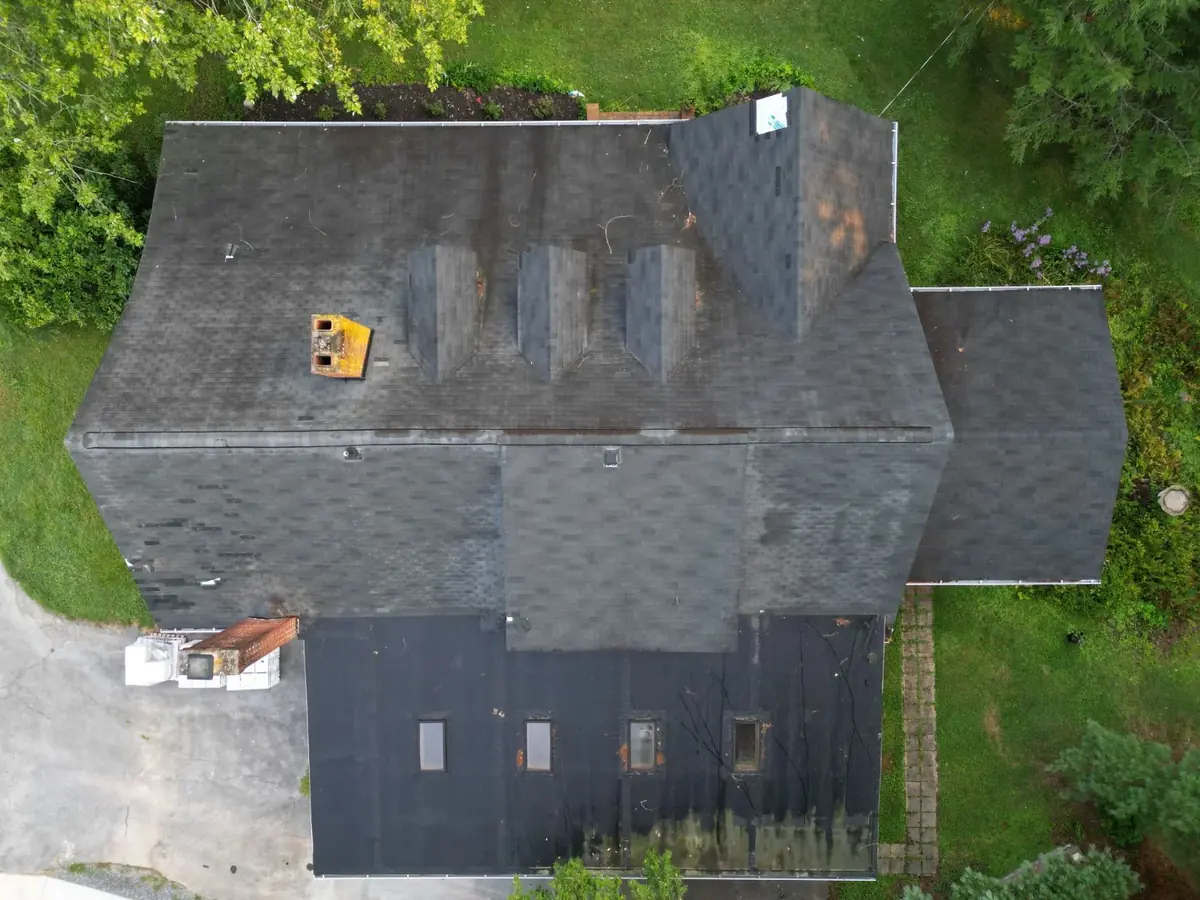
- Look at the south-facing slope from the driveway. Compare it to the north-facing slope. If the south side looks noticeably lighter, balder, or shinier, the granule layer is thinning. If you can see dark brown asphalt streaks through the surface from 30 feet away, that's a replacement signal.
- Pay attention to which shingles look "shiny." A shiny asphalt shingle is one whose granules have lost their grip on the underlying tar. Shiny + flat + brittle-looking = days, not years.
Granule loss in the first 2–3 years after installation is normal — shingles ship with extra granules that shed during the first weather cycles. Granule loss after year 15 is meaningful. Granule loss after year 20 is decisive.
Rule 3 · The 15% scope rule
This is the one we apply ourselves when we walk an inspection. If the total repair scope — meaning the surface area that needs to be touched, including any deck repairs uncovered during the work — adds up to more than 15% of the total roof area, replacement is usually the better economic decision.
Why 15%? Because at that scope, two things start happening:
- The cost of mobilizing, tearing off a section, color-matching shingles to an aging field, and integrating new flashing approaches half the cost of a full replacement — but you're putting that money against the oldest, weakest 85% of the roof.
- The color match almost never holds. Shingles fade with UV exposure; a 2026 batch of "Charcoal" doesn't match a 2012 batch of "Charcoal" that's been on the south slope for fourteen years. The visible patchwork affects resale and looks worse with each passing year.
Under 15%, repair is the right answer almost without exception. Over 25%, replacement is the right answer almost without exception. Between 15 and 25 is a judgment call that depends on the other two rules.
Putting the three rules together
None of these signals on its own forces a replacement. A 24-year-old roof with a sealed deck, intact granule layer, and a single damaged shingle gets a repair. A 12-year-old roof with one tree-impact area gets a repair. A 19-year-old roof with significant granule loss and a leak in the valley gets replaced.
The clearest decision rule we can give you: if two of the three signals are true, plan a replacement within twelve months. If only one is true, get a repair quote and a written inspection report — then sit on the decision and watch.
What an honest inspection looks like
When we walk a roof we photograph six things: the south slope's granule density, the valleys, the flashing transitions (chimney, sidewall, plumbing boots), the ridge cap condition, the attic underside (when accessible), and the gutter line. We send you the photos with the estimate. If we recommend a replacement, you'll see why before we say a word.
If a contractor walks your roof for ten minutes and tells you "you need a full replacement" without photos, without a written scope, and without offering a repair-only option — that's a sales call, not an inspection.
Not sure where your roof falls? Book a free inspection — we walk the roof, photograph it, and give you an honest answer in writing: repair or replace. Book your inspection →